
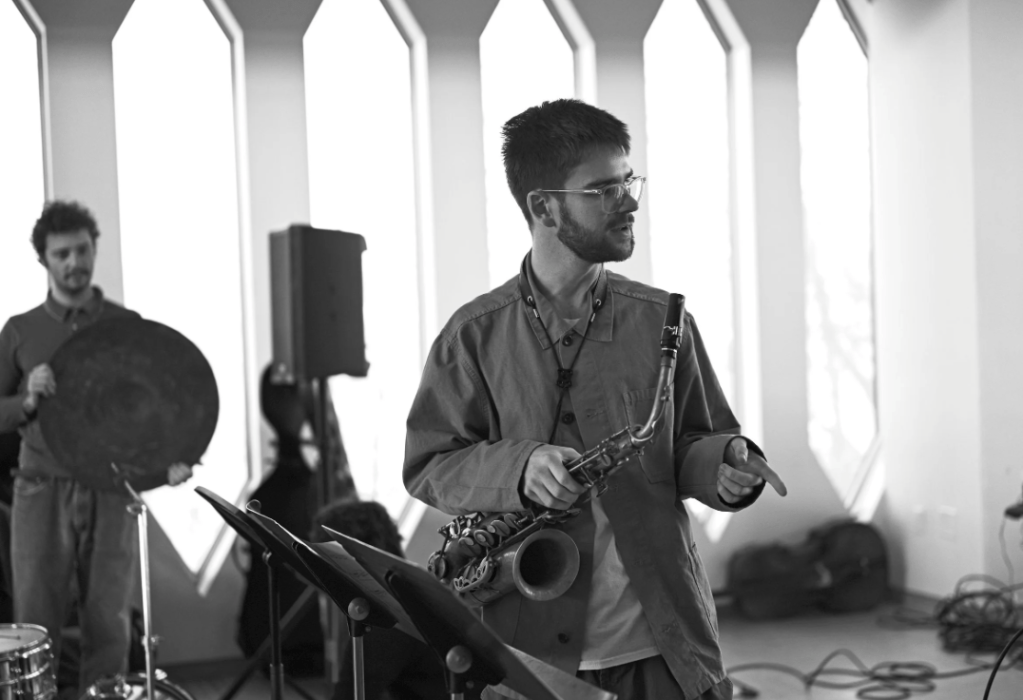
On the evening of April 4, dozens of students, professors and music enthusiasts gathered in Oberlin’s David H. Stull recital hall as George Rogers presented his senior recital. Rogers, a 4th year jazz saxophone major, had the room completely crowded. Not an empty chair in sight, folks were overflowing into the back of the performance space, hoping to get a good view. This recital was not one to miss. Anyone who knows Rogers is aware of his vast skills in performing all kinds of music. His musical contributions to campus range from swing, electronic music to drum and bass. There was no way of knowing what to expect upon reading the program.
The first half of the recital featured a trio, with John Hebert on piano, Milei Sagawa on bass, and Martin Kent on drums, assisted by Avery Ghose on trumpet. The program opened with That’s Earl, Brother by the great Dizzy Gillespie, played as a straight ahead standard. The energy in the room was high thanks to a great lock in the rhythm section and melodic conversation between the horn players. Rogers’ first solo solidified his musical reputation.
Perhaps the highlight of the recital was Rogers first original, unison, a piece he wrote for electronics. About 5 minutes in duration, it was completely opposite to the previous music he had played. No time signature and no distinguishable form. Rogers became his instrument, looping between sounds of indie folk and house influences, with the backing track featuring sonic soundscapes that flickered between electronic and live instrumentation. Rogers seamlessly echoed what was playing behind him through dynamics and changing tone. One could not know what was coming next, but could always be pleasantly surprised by it.
He rounded off his program with more originals, many of which have been played around campus and locally in Oberlin in acoustic quartet settings. This time, he arranged them for a nine-piece big band, entirely changing the sonority. Rogers extended the harmony through the horn section, allowing his melodies in originals such as find ways to see it and Home Song to float between the parts. He continued to combine his diatonic melodies with complicated jazz language and tight arrangements. Drum and electric guitar solos soared through the hall as everyone on stage had their chance to interpret what Rogers had written. Everyone’s focus was on the music, you could certainly hear a pin drop in the quieter sections. Rogers ended the program strong with his last original Grow, paloma.
A deserved standing ovation followed his last piece. Rogers has made the most complex of music accessible to an audience. With composing and arranging skills ahead of his time, he combined almost futuristic sounds with language of the great saxophonists that came before him. To be in that room felt like knowing a secret the rest of the world is soon to discover, as Rogers’ time at Oberlin comes to an end.


