
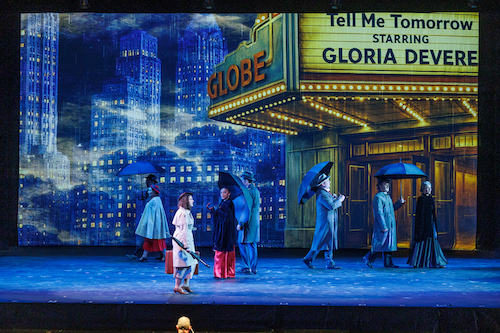
From Thursday, March 5 through Sunday, March 8, Oberlin Opera Theater presented two one-act operas, Later the Same Evening and Bastianello, in Hall Auditorium. Both composed by John Musto with libretto by Mark Campbell, the distinctly contemporary production was a departure from the more traditional works that the Opera department typically produces. I saw the show on Friday evening.
Later the Same Evening follows an ensemble cast in 1920s New York City as they prepare to and eventually attend an imaginary opera, See You Tomorrow. Campbell’s story, which he says “celebrates the serendipity of random human connections,” was inspired by scenes and figures from five paintings by renowned American realist painter Edward Hopper. Projected in rotation with a few original works curated by Projection Designer Brittany Powell Blascke, these five paintings featured prominently behind the cast throughout the show.
Ella Vaughn opened the evening as aggrieved wife Elaine O’Neill, setting the bar high with her unwavering soprano before being joined onstage by Finn Malarkey as her equally unhappy husband Gus. The show faltered a bit with the second solo, performed by Mackenzie Sturm as a nervous Estelle Oglethorpe about to go on her first date in a while. Sturm’s singing, although powerful, wasn’t as effortless as Vaughn and Malarkey’s dark, smooth cohesion. The final solo before the characters finally found themselves at the theater was performed by Isabella Balderrama as Ruth Baldwin, who sang a touching lament about preparing to leave for Indiana after having her heart broken.
Molly Chun stole the show as Italian diva Valentina Scarcella, whose impressively controlled vibrato was punctuated by moments of hilarious sarcasm as she complained about See You Tomorrow. Although the following duets and ensemble performances were all equally impressive, they fell flatter as the opera dragged on. By the time of the most emotionally engaging scenes, it felt like a slog to the end of the show.
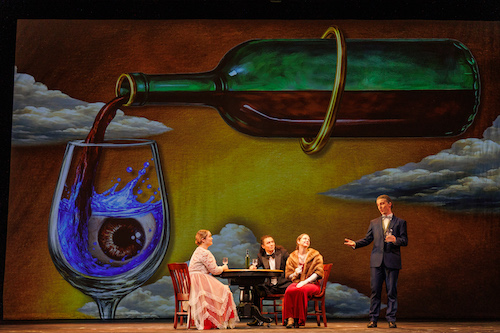
Bastianello was easily the more delightful of the two operas, in part because of the lighter-hearted storyline but especially because of the cast’s complete embrace of this silliness. Inspired by an Italian folk tale of the same name, Bastianello centers around the title character as he tells his psychiatrist about interweaving dreams, all from the perspective of his father, Luciano. The dreams, which follow Luciano’s search for six people more foolish than his new wife and their parents, are played out onstage in a hilarious embrace of the comedy of psychoanalysis.
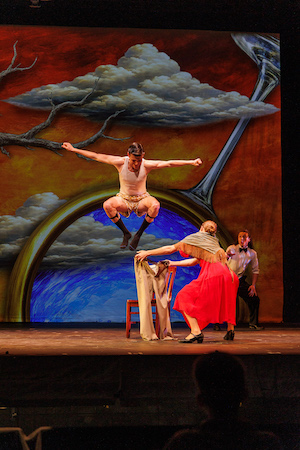
One scene, in which Ettalina attempts to help her husband Frediano put on his pants, was a clear highlight. Lydia Rommel showcased her acting skills through adept physical comedy, displaying full-body bewilderment as she exaggeratedly encouraged Will Sulkow to jump into a pair of pants. Ava Paul as Luciano’s new mother-in-law Ortensia also deserves recognition for her powerful, soulful soprano.
Director Scott Skiba’s vision was clear. Despite differences between the two operas, they found an abstract meeting point in their emphasis on individual self-reflection as a means to community. Nearly every character had their chance to shine, but these individual spotlights never detracted from the casts’ cohesion; the best moments occurred when many characters shared the stage. Although the relatively minimal set design by Laura Carlson-Tarantowski was almost swallowed by Powell Blaschke’s projections, this too placed the focus on the performers themselves.
Skiba’s modern theme was supplemented by the presence of Oberlin’s Contemporary Music Ensemble in the pit under the direction of Timothy Weiss. Despite strong performances from both casts, the CME’s performance of Musto’s scores carried the evening. Although the in-world opera in Later the Same Evening is never shown onstage, the audience witnesses the characters experiencing it over an extended orchestral interlude that paints a wordless yet complex story. While this romantic, free-flowing sound was an integral part of the storytelling of the first opera, Bastianello saw Musto using simpler yet still charismatic melodies which were often repeated. Where Later the Same Evening’s score laid the foundation for the production’s deep nostalgia, Bastianello’s music simply emphasized the opera’s hilarity and dreamlike qualities. Together, the two made a memorable evening at the opera.

 thecounterpoint.org