
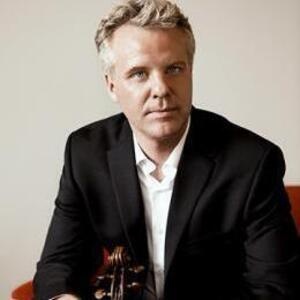
On the evening of February 21, an audience of College and conservatory students, faculty, and community members braved freezing conditions for an Icelandic- and Oberlin-themed solo violin program in Stull Recital Hall. Sibbi Bernhardsson, professor of violin, director of Oberlin’s string department, and a native Icelander, greeted the room with a permanent smile, ever-moving eyebrows, and enough warmth to dispel any lingering shivers.
Dalalæða, by young Icelandic composer Finnur Karlsson, was commissioned for the evening’s concert. Over its four movements, the audience trudges through a perilous hike before finally being met with an ethereal beauty, then yet more danger as water hits rocks and dissipates to mist. The piece begins with a demanding, off-kilter spiccato entirely on the G string, punctuated by a rare and strange harmonic. The second movement deepens and elongates the folksiness of the first with a dramatic melody that continues through the final two movements.
Bernhardsson noted that the next piece, And the Silence – in memory of a poet by Tryggvi Baldvinsson, was composed in memory of and based on one of the works of Baldvinsson’s good friends, Þorsteinn frá Hamri (Thorsteinn from Hamri). A rough English translation reads:
...and the silence
and the silence of the speech of two
who then resisted the temptation…
we manage, just for an instant
to gain a grip on the world.
The piece perfectly captures the sentiment of the poem as it explores silence and temptation. Bernhardsson’s bow barely scratched the surface before being juxtaposed with deep vibrato notes that grew to an aching finale.
Bernhardsson also selected two pieces from past and present Oberlin professors to deepen the evening’s theme of home, both of which also made use of traditionally Nordic sounds. The first, an expanding distance of multiple voices by Jeffrey Mumford, was a visual cacophony of chords and voices, just as the name promises. At moments, tender dissonance was punctuated by demanding harmonics. At others, harsh chords clashed with gentle runs. While each of the five movements made themselves known, one underlying theme managed to assert itself throughout: anger turned to anxiety turned to sorrow and back again.
Una Sveinbjarnardottir’s Kær, the second of three commissions, was strong and smooth right off the bow. Harmonics punctuated the end of gentle runs, allowing Bernhardsson’s glissandos to ascend straight to the heavens. It was peaceful but not calming, often haunting, provoking, and terrifying the audience at the same time. Kær ended by returning to earth, with a deep inhale and a long exhale.
Oberlin professor Stephen Hartke’s CAOINE was a fiddle tune derived from the laments of Irish whaling women. In between the more traditional double stops and bright riffs, there was an unhappiness that threatened to consume it all, blending in and out of sunnier moments for just milliseconds at a time.
More Steps, by Bernhardsson’s uncle Thorkell Sigurbjornsson, concluded the program. Composed as a gift for the violinist’s Oberlin graduation, the piece once again allowed him to display his gift for making difficult techniques sound easy — he began by using the wood of his bow to tap out a theme. Perhaps less technically complex than the other pieces on the program, it was filled with emotion: fast-paced and demanding, intense yet approachable. At one point, a series of pizzicatos sounded so angry that his string threatened to snap before Bernhardsson dove back into the fray with a medieval dance that grew more dangerous as it went on.
Bernhardsson and his violin were in intense conversation throughout the evening. While he was entirely in command of the instrument, at times it seemed that the violin had the upper hand — but his playing was delicate and never without purpose.

 thecounterpoint.org