
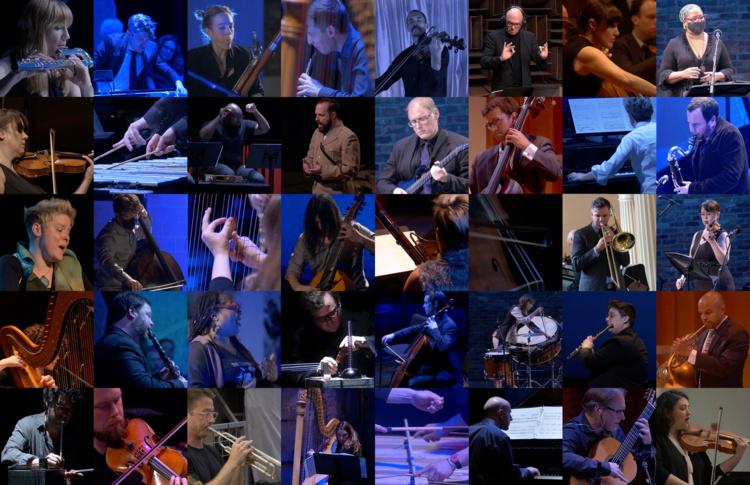
On Friday, March 14, the International Contemporary Ensemble (ICE) capitalized on its many Oberlin connections, as a number of its performing members are alums or current faculty. Conservatory students joined them in Warner Concert Hall to showcase Oberlin’s continued commitment to music of the modern era. An eager audience witnessed a wide variety of composition styles. Truly beyond the ordinary, the program featured unique soundscapes as well as the experimental.
The performance was a full circle moment for the ensemble. Setting the stage for the evening, percussion professor and performing member of ICE Ross Karre explained that some of the ensemble’s members played together under the direction of Tim Weiss, who encouraged them to seek out works by their peers studying composition.
Appropriately, a work by Courtney Bryan ’04 opened the program. A student woodwind quartet explored the inherent dynamic of conversation in Blooming. Bryan particularly emphasized the process of weighing different viewpoints. The imagery first considered how this process appears in dialogue among multiple people but shifted to reveal that this also occurs within oneself. The airy tone of the flute and clarinet embodied the personalities of those speaking, while the bassoon was a constant counterpoint. And the horn was a reminder that even ideas have consequences.
Harpist Nuiko Wadden ’02 then joined a student string quartet for Leila Adu-Gilmore’s Alyssum, a vibrant portrait of her own mother. In the opening, and intermittently throughout, percussive plucks of the quartet gave structure to the liquidity of the harp. Wadden’s instrumentation primarily served to broaden the landscape. In the climax, she provided the surrounding aura of a glimmering sheen produced by long strokes by the violin bow.
The opening pieces were simple in their expression but concise in their delivery. Specifically, the transitions between delicacy and soaring highs were convincing but quickly became repetitive. Allison Loggin-Hull’s The Pattern was a definite change of pace. The woodwinds and violin culminated to produce a haunting shriek. Then placed over the hastening march of the percussion, the image of one being chased was distinct and terrifying.
Clarinetist Josh Rubin ’99 dominated the remainder of the program. He introduced Echoes by Olly Wilson, noting that he was a professor of composition in the 60s and laid groundwork for what would become the TIMARA department. Backed by a track of springing frequencies, Rubin was the singular musician on stage. He blew angular shrills into the air, reminiscent of a racing Coltrane solo. Wendall Logan’s Duo Exchanges and Yaz Lancaster’s intangible landscapes were similar pieces and incorporated other ICE members. Certainly “experimental,” as Rubin put it, the sequence of pieces that included electronic elements did not fit in with the rest of the program.
Again shifting the mood, Building Stuff for large ensemble by Nicole Mitchell was the performance’s stand out. Actual baby toys suggested the fun that was to come. Then, like a big-headed, tottering toddler, the ensemble emerged with a sound both sweeping and playful. Its imagery most closely resembled the routine of the characters in Toy Story. Freedom was projected, before the toddler entered back into the room, causing the toys to go rigid.
Undeniably, ICE demonstrated itself to be a group that travels into territory unknown. The challenge of that feat is constructing a cohesive program. As so many of the performers were alums, their intimacy with Oberlin suggested that the audience would be excited to hear anything as long as it was well played. True to an extent, but content is just as important as quality.

 thecounterpoint.org