
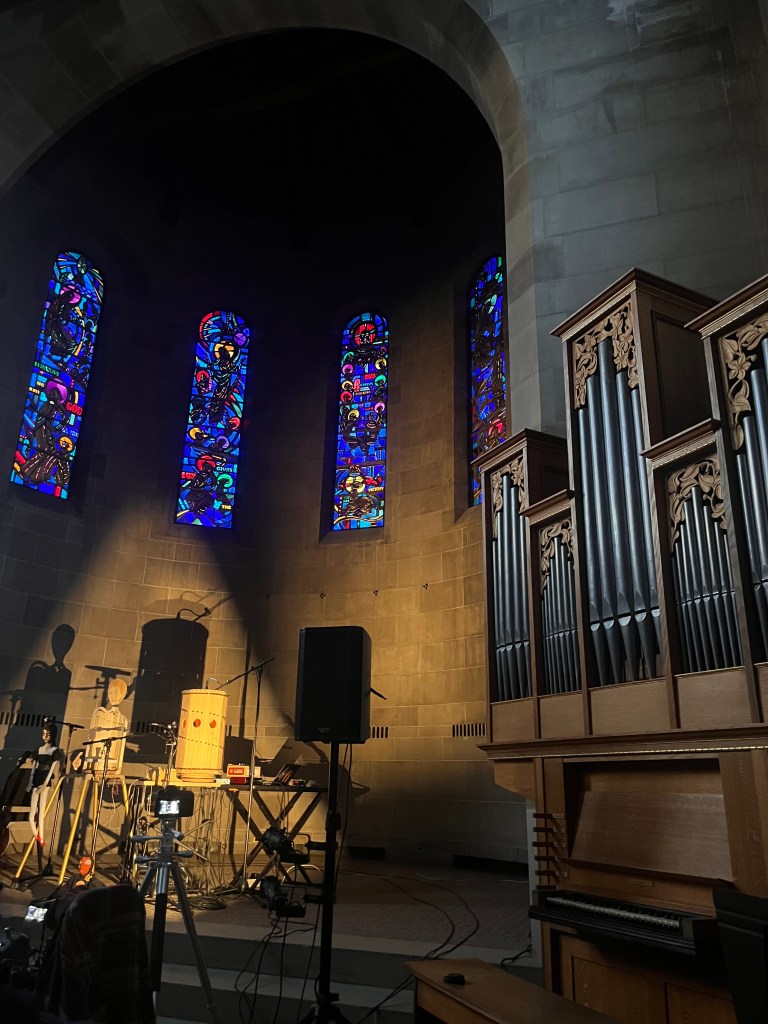
If Oberlin Conservatory’s Technology in Music and Related Arts (TIMARA) program were to be described in one word, “unconventional,” would likely be a top candidate. Upon arriving in Fairchild Chapel on the evening of March 13, 2025, it was clear that Fae Ordaz’s junior TIMARA recital would live up to this reputation. On stage was a beautiful gallery of handmade instruments connected by a network of pulleys and ornamented with sculptures, portraits, and a haunting shadowy backdrop. The visual aesthetic of this setup was worth admiring on its own, yet the real intrigue lay in exactly how Ordaz’s storytelling would proceed.
Once she took the stage, the instrumentation began to reveal its mysteries. Ordaz started her first piece, “I Couldn’t Imagine”, by pumping a pedal underneath her cylindrical harp, causing it to rotate. As the system of pulleys came to life, the mechanical whirring of her contraption evoked the imagery of a 19th century textile mill. This cyclical hum was soon joined by a shrill creaking that was occasionally reminiscent of a melody. As she began strumming, the jagged temperament and coarse tone of her harp further characterized the industrial-sounding nature of her instrumentation.
Her first vocal entrance marked the climax of the growing cacophony. Ordaz’s use of a distortion filter during her pulsating vocal swells added a sense of impermanence to what would otherwise have been a moment of resolution. As the soundscape became less busy, a soothing electric guitar melody performed by Ben Hochester emerged from the texture. This gradual decrescendo concluded with a single note sustained over several breaths of Ordaz’s accordion-like gwinna. Her keen attention to dynamics and vibrato gave this pitch a remarkably buoyant shape as its bright timbre filled the chapel.
As she continued into her second and final piece, “When I Turn”, the droning of the gwinna was replaced by a harsh, grinding tone from her harp. Hochester, now playing an acoustic guitar, had a more active role. His creeping rhythmic motifs combined with Ordaz’s coarse-sounding harp ostinato evoked the mysterious edge of a Morricone film score. As his interjections slowly gravitated to a major key, Ordaz’s harp arpeggios and industrial-inspired scraping embraced a more pleasing, energetic feel. Her ability to flip the emotional character of the music while relying on her carefully chosen palette of sounds was remarkable. The performance concluded as the gravelly tones from Ordaz’s harp came to the foreground, creating the effect of a train grinding to a halt.
Ordaz explored the relationship between the impermanence of life and the permanence of change just as much in her visual presentation as she did through her music. The frequent pauses she took to reconfigure the strings connecting her pulley system called much attention to the transience of life and of man made creations. The cyclical nature of her instrumentation as represented by the respiration of her gwinna and of her rotating harp beautifully emphasized the unceasing nature of change. This was further highlighted by the light shining through her harp which closely resembled lunar cycles.
Over the course of her recital, Ordaz showcased a tremendous variety of creative techniques that culminated in the presentation of an emotionally and intellectually enriching story. Her ability to seamlessly blend sound and visual symbolism made for a performance that masterfully demonstrated the versatility and ingenuity for which Oberlin’s TIMARA department is known.

 thecounterpoint.org