
“There’s going to be God – and bananas!” was Oberlin composer Marshall Engel’s advertising pitch for the second-year composition studio midway concert. There was, in fact, God – and bananas.
The beginning of second semester marks the composition department midway concerts – and second-years had their turn on March 22, at 2:00pm in Clonick Hall. Calvin Ray Shawler, Jonny Ollendorf, Chloe Biggs, and Marshall Engel wrote pieces of four vastly different genres, creating an hour-long presentation of seriousness and whimsy.
Shawler’s Faces Without Features takes inspiration from weathered sculptures in an archaeology museum. Played by the Cyrus String Quartet, each movement explores these artifacts programmatically, where ominous developing motifs represent their unveiling from ancient humanity. The first and third movements are serialist, constructed from eerie twelve-tone rows, leaving lingering dissonances. The second movement showed the virtuosity of Gabe Nichols (violin 1) and Ma’ayan Kertcher (cello) with melodic solos, fleshed out by repeated scales in accompanying parts.
As the advertising pitch suggested, bananas were there. Jonny Ollendorf, with Chapin Dobbins and Z Campbell, wrote a musical skit about the realization of what berries are. Though Dobbins sang and played a tam-tam, and Ollendorf played some recorded sounds, the work focused on Campbell’s deep mental thoughts regarding childhood lies and the discovery of the botanical truth of berries. While bananas unfortunately were not covered extensively, Campbell did throw an open container of raspberries on the floor. Satirical pieces are an enjoyable addition to the musical repertoire, especially from composers as talented as Ollendorf.
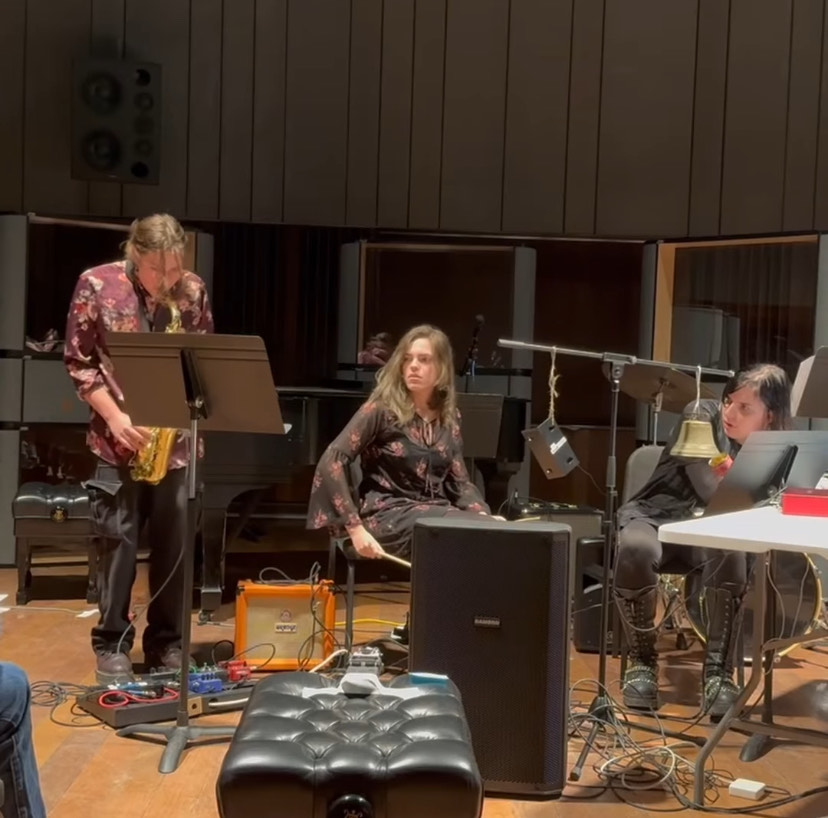
Bucket Music was Biggs’s experimental amalgamation of sounds, using capture mics on a bucket, bell, and can, accompanied by saxophonist Indigo Brandstein, adventuring through the unique soundscape. Biggs herself noted how the can acted as a distorted microphone, which was used by Gwen McKee (percussionist and programmer of the electronic processing) who at one point held it to the bell of Brandstein’s saxophone. The work also featured McKee violently hitting a bucket to the point where both it and the mallet were destroyed, and Biggs attacked the can.
In a genre-shock conclusion, Engel kept his promise of spirituality in 3 Love Songs from a Razed World, sung by Max Novik. Each was a setting of a translation of a devotional Yiddish poem, with a backing ensemble of guitar, bass, drums, and piano. Novik sang with a peaceful, deeply rounded tone, best heard in the second song – a duet for voice and guitar. Grant North navigated ethereal guitar arpeggios which complemented the singing. The first and third songs called for the whole ensemble, and grooved with the help of Ori Jossel’s light, brushed percussion. Unfortunately, in those two songs, the accompaniment drowned out the vocals in certain places. This set of three songs is the beginning of a larger work, which will be premiered in late April.
Oberlin’s composition department is home to a vast array of styles, genres, and backgrounds, which were explored thoroughly during the show’s one hour runtime. Every concert of theirs displays unique personalities from each composer, which are always a surprise. Unless God – and bananas are promised, in which case you can expect God – and bananas.

 thecounterpoint.org