
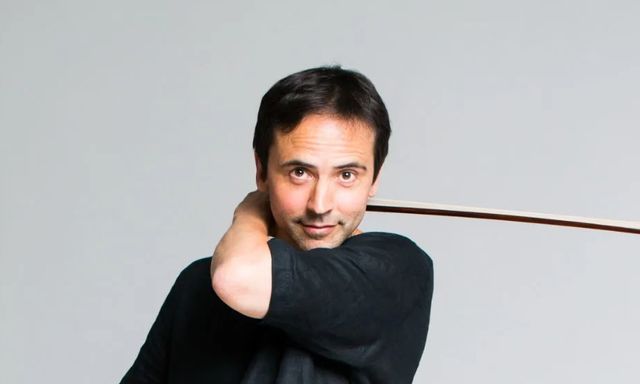
On Saturday evening, February 24, The Cleveland Orchestra embarked on a familiar journey nowadays, by bringing new life to old pieces. With Ludwig van Beethoven’s Overture to Egmont, and Symphony No.6, “Pastoral” programed, many old and young listeners took to the seats of the beautiful Severance Hall with high expectations. Although, the god amongst men comprised two-thirds of the program, the highlight of the evening was Joseph Haydn’s Cello Concerto No.1, performed by French cellist Jean-Guihen Queyras.
Conductor Philippe Herreweghe shuffled towards the podium, just in time tostart the concert. After making numerous abstract air drawings, Herreweghe led the orchestra in their program opener, Overture to Egmont. Created as a dramatic work for Wolfgang von Goethe’s 1788 play, Egmont, the Overture is often played by itself in concert halls. Its ominous and dark beginning becomes lighter and more energetic as the piece continues, ending the piece with a grand and majestic atmosphere. This piece allowed the “World Renowned” Cleveland Orchestra to prove why their playing is so famous. With a string section tighter than the Chicago Symphony, and a wind section in close contention to the New York Philharmonic, Beethoven’s Overture tastefully highlighted the orchestras technical and musical prowess.
After a quick stage change, the real show was set to begin when Queyras walked on stage. With a bohemian yet refined attitude, Queyras demanded the attention and respect of the audience before ever playing a note. With no endpin, the concerto began, and the virtuoso brought this early work to life while loosely following century-old rules. With his abrupt use of col legno and his free interpretation of time Queyras shared a playful, and passionate story from beginning to end, inviting audience members to hear their stories through his. At the conclusion of his performance, there was a moment of unusual bliss in Severance— no one coughed, clapped, or moved in their chair. However, the cellist was quickly met with several standing ovations and calls for an encore. Queyras humbly obliged after bow number three and performed J.S. Bach’s Prelude from Suite No.4 as his encore before leaving the stage for good.
After Queryas it was hard not to be excited about Herreweghe’s interpretation of the Beethoven’s symphony. However, the nature-based symphony proved to be written too skillfully to be reinterpreted. With the Herreweghe shuffle happening on the podium, it was unclear whether the orchestra was trying to stick with Beethoven’s intents or the conductors dance moves. Throughout the five, dreadfully repetitive movements, there were good and bad moments. Movements one and two, were performed beautifully, remaining light and free as if they werethe scenes of nature Beethoven had recreated. Movements three through five however, were painfully out of tune, sluggish, and lacked the diverse beauty of nature Beethoven worked tirelessly to portray. Even so, after an evening of exquisite music making The Cleveland Orchestra produced a fresh, memorable and fun concert that many would consider to be one of its best this season.

 thecounterpoint.org