
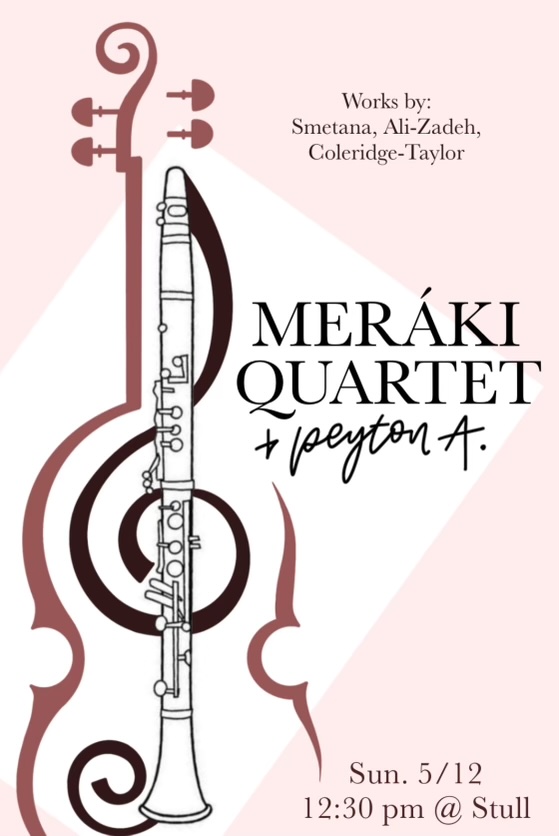
As most Oberlin College students prepare for their summer activities, one student-based chamber group has a final performance to deliver before heading off. The Meráki String Quartet — violinist Ben Seah and Laoise Matsumoto, violist Solomon Leonard, and cellist Michael Bridges — will be performing at 12:30 pm on Sunday, May 12, in Stull Recital Hall. The concert will present a diverse program that includes Bedřich Smetana’s String Quartet No. 1, Franghiz Ali-Zadeh’s “Dance,” and Samuel Coleridge-Taylor’s Clarinet Quintet, featuring myself on clarinet.
The Meráki String Quartet — although relatively young — is making a name for itself at Oberlin through its energetic performances and its commitment to exploring a wide range of repertoire. This concert perfectly encapsulates that spirit, bringing together classical masterpieces, contemporary works, and a collaboration with a guest soloist.
The program opens with Smetana’s Quartet, commonly known as “From My Life,” a musical autobiography, in which the Czech composer reflects on his journey through life, capturing the emotional highs and lows that shaped his career. “We felt that this would be a great opener, seeing that it is the end of the school year. It will allow audience members to reflect on their year through Smetana’s music,” Bridges said.
The first movement’s energetic and tumultuous themes contrast with the serene beauty of the second movement. As the quartet navigates the dramatic third movement, the audience is reminded of Smetana’s own personal struggles, including his hearing loss. The poignant final movement, with its haunting high-pitched note symbolizing Smetana’s tinnitus, powerfully closes the quartet. The Meráki Quartet’s sensitive interpretation of this work is sure to resonate with the audience, capturing the essence of Smetana’s life story.
The concert then moves to the contemporary realm with Ali-Zadeh’s “Dance.” Ali-Zadeh, an Azerbaijani composer, is known for blending traditional
and contemporary musical elements, drawing on her rich cultural heritage while pushing the boundaries of classical music. “Dance” is a compelling and rhythmically intricate piece that requires a high level of precision and coordination among the quartet members.
“This piece is a lot of fun to play. We were asked to perform it at Oberlin’s Day of Connection event back in April. It was a challenge mainly because of how non-western the piece is,” Leonard said, adding that “being a short work doesn’t make it an easy one.” Nevertheless this piece will undoubtedly highlight the quartet’s versatility and technical prowess, offering a thrilling and vibrant contrast to the preceding Smetana.
Coleridge-Taylor’s Clarinet Quintet is a work of lush harmonies and expressive melodies, demonstrating the composer’s deep understanding of both the string quartet and clarinet. “Throughout the piece, audience members will bear witness to intimate conversations between the clarinet and strings,” Seah said.
Coleridge-Taylor, a Black British composer and contemporary of Edward Elgar, often incorporated elements of African American music into his works, setting him apart from many of his contemporaries. “His quintet is similar to that of Brahms with his brilliant use of harmony and texture,” Matsumoto said, “but in Taylor’s, you won’t find yourself dozing off.”
On a personal note, my favorite part of Taylor’s quintet is by far movement two when the clarinet has a beautiful and soulful melody that is passed between instruments and then further complemented with familiar duets. This quintet explores a wide emotional range, from playful to melancholic, and culminates in a lively finale that brings the concert to a joyous close.
This concert is a significant moment for the Meráki Quartet and myself as we prepare to go our separate ways for the summer. It represents both the end and the beginning of a musical journey they’ve shared throughout the academic year while setting the stage for future collaborations and performances.
For those in Oberlin, this is an excellent opportunity to hear a talented group of musicians at the cusp of their careers, showcasing a diverse and engaging program that promises to be both moving and memorable. “We are really excited for what the future holds for us,” Bridges said. “This concert is not only intended to be a showcase of our semester’s work, but it’s also an invitation for our audience members to reflect on their year.”

 thecounterpoint.org