
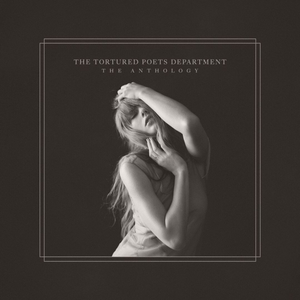
Two hours after Taylor Swift released her eleventh album The Tortured Poets Department, she surprise-released a bonus disc, subtitled The Anthology, doubling its length to over two hours. Few of those extra tracks earn their place on the full record, and their inclusion makes the double album a more arduous listen than it needs to be. But despite being Swift’s most bloated project, The Tortured Poets Department is really good.
Every album of Swift’s sounds different from the one before; she couldn’t have executed the Eras tour if 1989 sounded just like Reputation. But The Tortured Poets Department is the first record Swift has made that breaks this rule. She and co-producers Jack Antonoff and Aaron Dessner keep cultivating their soft, comfortable sound where they turn the dial to various levels of synthy, and thus the album explores zero new sonic directions. But it’s not fixing what isn’t broke, and it sounds pleasant. The instrumentation is just audible enough — and no more — to power the lyrics with some of Swift’s cleanest melodies to date, and it goes down like milk — which it needs, to match the album’s lyrics.
Those lyrics are universally unhappy and bitter, with Swift’s voice angry and resentful like never before. Most Swift songs are ambiguously autobiographical; here they’re probably influenced by her recent romantic tumult. Those specters of real-life drama loom over the album more than they have any right to, overshadowing the music itself. Regardless, The Tortured Poets Department is a front-to-back breakup record, with lyrics that prove among Swift’s most moving.
“But Daddy I Love Him” features sweeping string instrumentation over a story of rebellious romance, with Swift singing:
I’d rather burn my whole life down than listen to one more second of all this bitching and moaning
I’ll tell you something about my good name, it’s mine alone to disgrace
“I Can Fix Him (No Really I Can),” which plays like its twin song, paints whole lives in Swift’s standoffishly confident, Lana Del Rey-ish delivery of:
I could see it from a mile away
A perfect case for my certain skillset
He had a halo of the highest grade
He just hadn’t met me yet
Chief among the album’s highlights is “Who’s Afraid of Little Old Me?” where Swift, fed up with her own gargantuan status and perception, paints herself as a messy combination of asylum patient, freakshow attraction, and vindictive party crasher, over deceptively pleasant music that makes the song that much darker by realizing a twisted fairytale atmosphere around it. It’s genuinely scary, the perfect example of how this album’s ethos works track-by-track, and the best song Taylor Swift has released in a decade.
But though none of the songs on the first disc are bad, they’re good only for similar reasons. They’re all moody, moving, and slow. Opening track “Fortnight”, a lush, darkly romantic duet with Post Malone, is Swift’s moodiest and slowest lead single ever. It was probably chosen only for its guest verse, because it’s not much more accessible than the rest of the album.
Indeed, what’s absent most from The Tortured Poets Department is a pop hit. It doesn’t have a single “22,” a “Style,” or even an “Anti-Hero.” It’s made of thirty-one wordy, inaccessible album tracks that are rarely any fun, and that fun is what’s missing from an artist who’s generationally great at making hits. The songs are just not that catchy or loud, and if they still meet success, it’ll be only on their pedigree as Taylor Swift songs.
The Tortured Poets Department, at its worst, can feel like a breakup album on autopilot, with Swift prioritizing a lyrical statement over a musical one. It’s difficult to recommend because of its moody monotony. At its best, however, it’s a culmination of the collaborations she began with Antonoff and Dessner: the end goal achieved, the mode perfected. Swift leaves The Tortured Poets Department with nothing left to prove working in that groove.

 thecounterpoint.org