
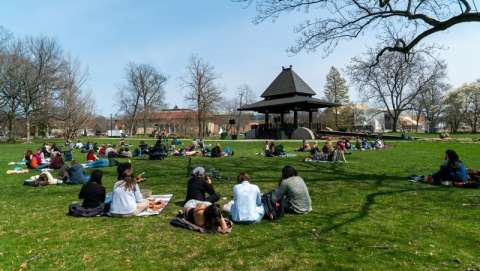
Every year since 1999, Oberlin College’s Folk Music Club has hosted Folk Fest — a free weekend-long music festival that brings in musicians and bands to perform in Oberlin. This year’s will run on Thursday, May 2 from 7:00 to 11:00 pm, Friday, May 3 from 8:00 to 11:00 pm, and Saturday, May 4 from 12:30 pm to 12:30 am.
Folk Fest is run entirely by Oberlin students — specifically, it is run by the college’s Folk Music Club. One of the oldest student organizations at Oberlin, it was founded as the Folk Song Club in 1957 by Joe Hickerson ’57, best known for co-authoring the song “Where Have All The Flowers Gone?” with Pete Seeger. According to Rosalie Coleman and Ryan Michaud, who spoke about this year’s festival, folk music concerts at Oberlin precede Folk Fest as an institution. Planned, booked, and operated only by students, it is run by new people each year. “The fact that there’s a rotating group of organizers is a cool feature, because you can see the progression of who’s interested in it,” said Coleman. “It’s a metamorphic festival.”
Indeed, Folk Fest hosts different kinds of events each year, including concerts by visiting and local musicians. Also featured are talks and interactive events where musicians perform and discuss their songs and answer audience questions, and jams — collaborative music-making sessions that bridge the time between concerts. “They might have a leader, but usually they’re just a group of any number,” Coleman explained. “Anything goes, sometimes, other times they might be more genre specific, focusing on bluegrass or Irish tunes. Sometimes they’re instrumental only. It depends on who’s in it.”
“Workshops and jams are usually a big part of folk festivals,” Michaud said. “People usually just play for fun together, whether events are organized or spontaneous. We’ve talked about having some more formalized jams this year.” These include a session at the Tappan bandstand from 10:30 to midnight on Friday night after that evening’s headlining concert, and another from 5:30 to 9:30 on Saturday evening that will include a complimentary pizza dinner for attendees.
Folk Fest doesn’t just bring prominent artists to town — it also showcases performers from the Oberlin community and the student body. This year, eight local bands will be featured performers — three student acts and three community acts will perform in 30-minute sets at the Cat in the Cream cafe on Thursday night starting at 7:00, and one of each will open there for Friday night’s visiting headliner, the trio Cactus Rose, led by singer-songwriter Kandia Crazy Horse.
Folk Fest typically features performances at multiple venues, and this year is no exception. Traditionally, the Saturday guest artist performs in Finney Chapel, but Coleman described it as “a hard space, because it’s meant to be full, and [Folk Fest doesn’t] get the attendance to fill it.” Performing instead in the Dionysus Disco, this year’s Saturday night headliner is the Scottish band Talisk, described by Coleman as “a really high-energy headliner who is a good fit for the Sco.” The trio features Benedict Morris on fiddle, Mohsen Amini on concertina, and Charlie Galloway on guitar, as well as some live electronics and foot percussion. Though the band rarely plays smaller venues like the Sco, their high-tempo music and performance chemistry should work well in its club atmosphere.
Though planning the festival is a year-long process, Coleman and Michaud are up for the challenges that organizing it brings. “It’s cool especially because it’s part of such a long tradition, and we get to keep it alive. It’s the main thing that Folk Club does. The historical aspect of it gives it weight, especially for getting funding from the college,” Michaud explained, and Coleman added, “Folk Fest is why I came to Oberlin. I knew it was entirely student-run, and working with artists and agents is a cool opportunity.”

 thecounterpoint.org