
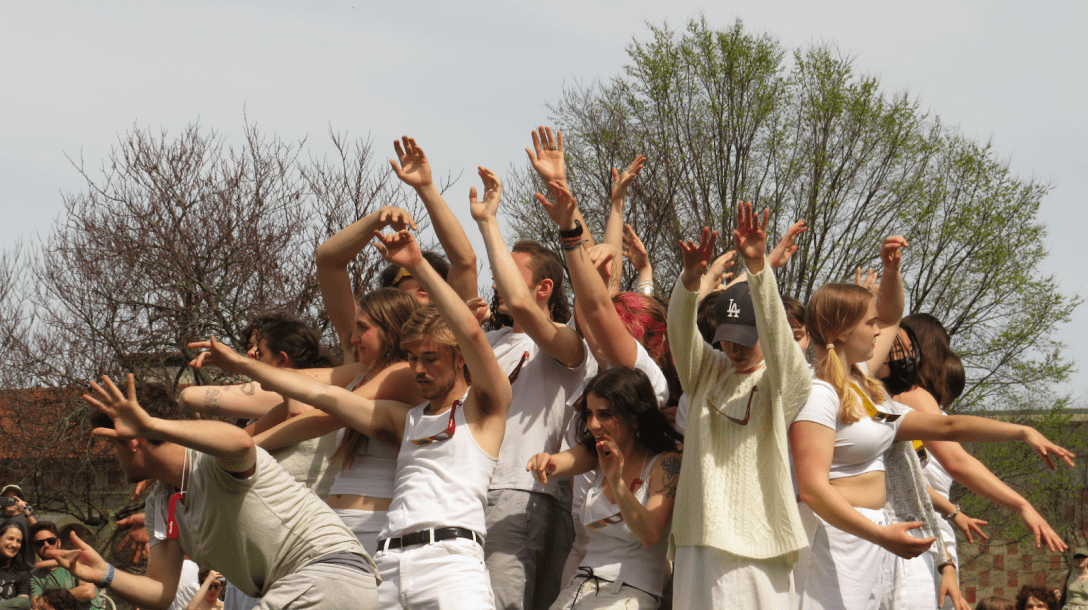
On April 8, 2024, crowds gathered across America to witness the celestial event of a lifetime: a total solar eclipse.
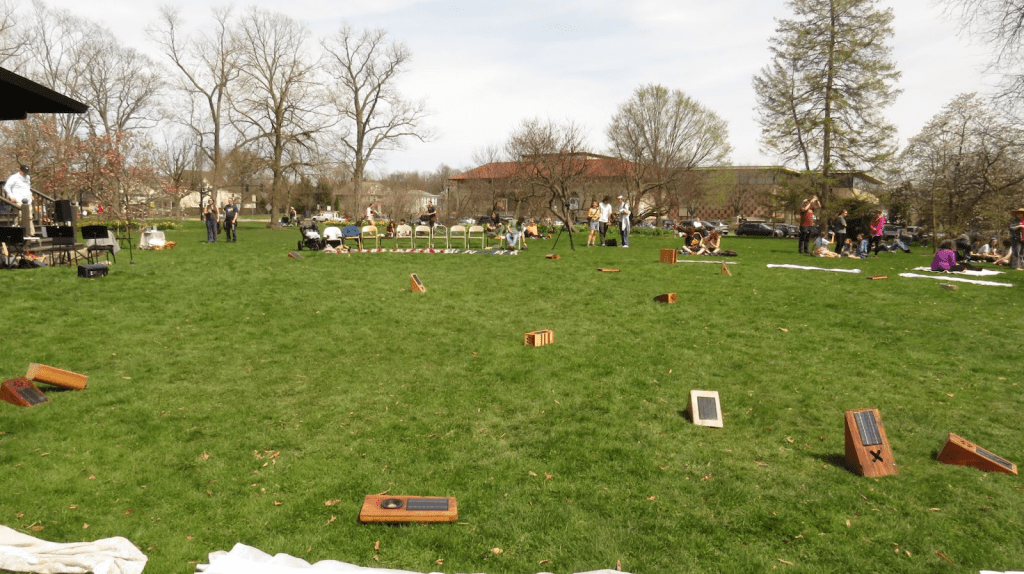
Oberlin was in the path of totality, and, in typical fashion, the college celebrated this “OCLIPSE” in unconventional ways. As such, there was the TIMARA section of the OCLIPSE Concert Series, an eclipse-centric contemporary dance and experimental music performance set by the bandstand in Tappan Square. The performance featured students of the TIMARA department’s Oberlin Improvisational and Newmusic Collective (OINC) and the Contemporary Dance Technique class, working with OINC’s instruments and Daniel Fishkin’s Solar Sounders, handcrafted wooden synthesizers that generate sounds based on how much sunlight they receive.

OINC director Dr. Steven Kemper described the performance as “more of a happening than a concert,” and a happening it was. The park was abuzz with college students, Oberlin residents, and out-of-towners alike, some traveling across multiple states. Observers stood around the circular performance space next to the bandstand. Some — myself included — were lucky enough to get a front row seat on the grass at the edge of the circle. In the time before the concert began, the Solar Sounders scattered about generated spacey pulses, setting the tone for the imminent eclipse. The organizers held a so-called “participatory water ritual,” in which concertgoers took plastic glasses of water from a table by the bandstand and walked them to the outer edge of the circle to pour the contents into collective bowls. As we walked, my friends and I were instructed to focus on what we want our lives to be like after the eclipse. It felt a bit silly at first, but I was surprised by how at peace it made me feel.
The performance itself was ritualistic and spiritual in nature. Symbolic of the eclipse, the dancers, dressed in white, came in and out of the circle, uniting and dispersing repeatedly. They picked up the Solar Sounders and moved them around, the pulses oscillating between shrill highs and growling lows. The dancers alternated between vigorous and loose movements, the releases of tension lifting the excitement of the celestial event. A disembodied voice announced to the dancers commands with corresponding movements, ranging from “begin” to “resolution” — among the more interesting commands were “celestial body” and “centrifugal force.”
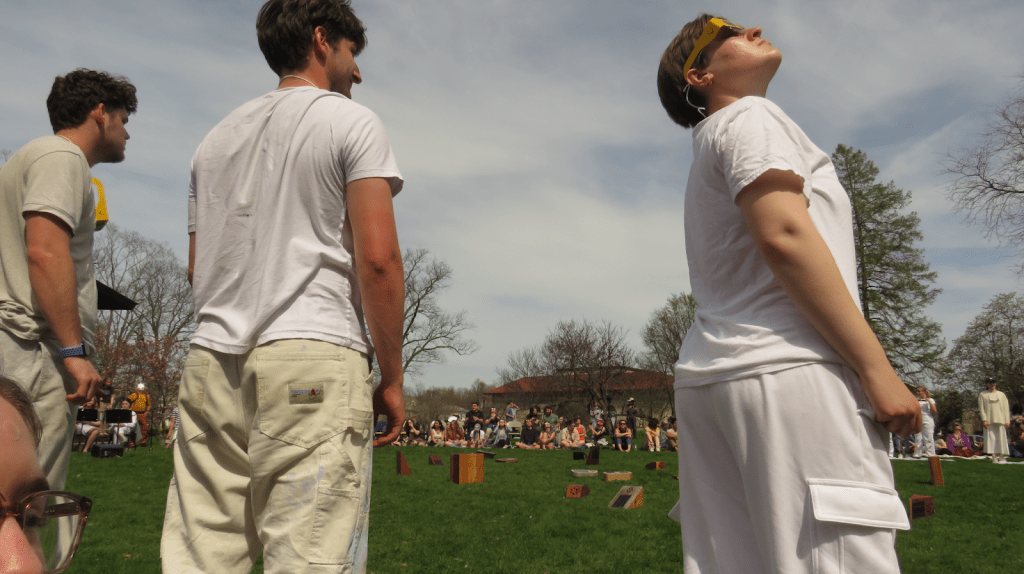
The dancers wore eclipse glasses around their necks, occasionally stopping to look up as the sun and moon inched towards each other. Their engagement with the eclipse didn’t detract from the performance — if anything, it made it more immersive. The audience and the performers were united in anticipation of the event of a lifetime.
Several minutes into the dancers’ performance with the Solar Sounders, OINC began playing. Their first movement was melodic, with a warm, soaring saxophone melody from Indigo Brandstein and tenderly plucked electric bass from Max Curley. Aman Roy’s electric cello drones and Henry Samra’s accordion provided the basis for the shimmering wall of sound. All of the instrumentalists blended beautifully, evoking a sense of tranquility and renewal in the time before totality.
Everything went still for the duration of totality. The performers were given a break to look up. The Solar Sounders were flipped over in reverence.
Afterwards, the instrumentals made a dramatic shift to the atonal. Dancers continued to come in and out of the circle, forming small groups that danced in sync while others moved independently. OINC’s sounds came in harsh staccato bursts as the dancers embraced each other and converged and dispersed repeatedly.
The performance started to drag toward the end, and the audience became less engaged after the big event of the day. There was a loud, urgent flare of instrumentation that felt final, but then came a denouement that overstayed its welcome. By the actual final flourish and the dancers’ exit, much of the audience had already left and the remaining crowd was no longer enraptured. It seemed like the natural progression of things to witness such a stunning celestial event and then lose interest in everything that comes directly after.
The happening was a wonderful complement to the otherworldly beauty of the eclipse. It was a uniquely textured way to experience such an event, and the technical ability of both the dancers and the instrumentalists, as well as their dedication to such an ambitious project, was evident in every movement.
Photos courtesy of Hazel Feldstein and Sloane DiBari.

 thecounterpoint.org