
The Allen Memorial Art Museum is presenting “A Day of Connection: Art, Music, and HIV/AIDS” on Saturday, April 13. This full day event, from 11:00 am until 5:00 pm, will feature the museum’s current exhibition “The Body, the Host: HIV/AIDS and Christianity” in Ellen Johnson Gallery, with chamber music by Oberlin Conservatory musicians and performances by Oberlin College theater students.
I recently met up on Zoom with Hannah Wirta Kinney, the Curator of Academic Programs at the Museum. I began the conversation by asking her how they came up with the idea of connecting HIV/AIDS and Christianity.
Hannah Wirta Kinney: Sam (Sam Adams, Assistant Curator of Modern and Contemporary Art at the Museum) was working on two exhibitions, one on Christianity, one on HIV/AIDS. They came to realize that many artists who identified as queer and suffered from HIV/AIDS grew up in Christian households. Sam began to be interested in how Christian youth influenced the way they thought about this moment of crisis, about redemption, salvation, and found how those themes kept coming up again and again.
Sicily Xiao: Why do you want to bring music and theater into the event? How did you recruit students and professors from college and conservatory to participate in this program?
HWK: Sam is really interested in programs that enliven the galleries and thinks about the exhibition as a performance stage when they curate. So early on, even before the exhibition was up, we started having conversations with various people in the conservatory and the theater department to begin to develop this program.
Kirsten Docter, Associate Professor of Viola and Chamber Music at the Conservatory, was really interested in the program. Strings are easy to bring into the galleries, so it seemed a good fit to experiment with the string quartet. She brought Daniel Knapp 24’ in to help develop the idea. Then we started advertising the program on our website. An alum, Aaron Wolff 17’, reached out to us. He has been performing music by Arthur Russell, who also died of AIDS, and was wondering if he could come play his music as part of this day.
With the theater group we started talking with Anjanette Hall, Assistant Professor of Theatre at the College, about doing scenes from Angels in America which is about HIV/AIDS and has scenes about Christianity. What has been really meaningful for me is all of the collaborations that we’ve had. The museum could not do this without all the other people.
SX: Is this the first time you have hosted performances in the museum?
HWK: In recent years we have had some performers as part of our open after-hours series. But this whole day of events with music and theater in the gallery where the exhibition is located is definitely new during my time. This is the first time we’ve done something of this magnitude.
SX: Are there any other events on this day?
HWK: We’re going to display materials from the archives about the history of AIDS activism on campus, artists’ books from the Clarence Ward Art Library, and the Multicultural Resource Commons will be there too. Gil Kudrin will talk about his own artwork in the exhibition [after the chamber music] and then the gallery talk after the theater performance will be about the work of Jerome Caja. So the whole day will be devoted to different ways of connecting with the exhibition, and also connecting with different people at points of view. You will get a diversity of perspectives, and those different ways of thinking about the content will give you a broader picture.
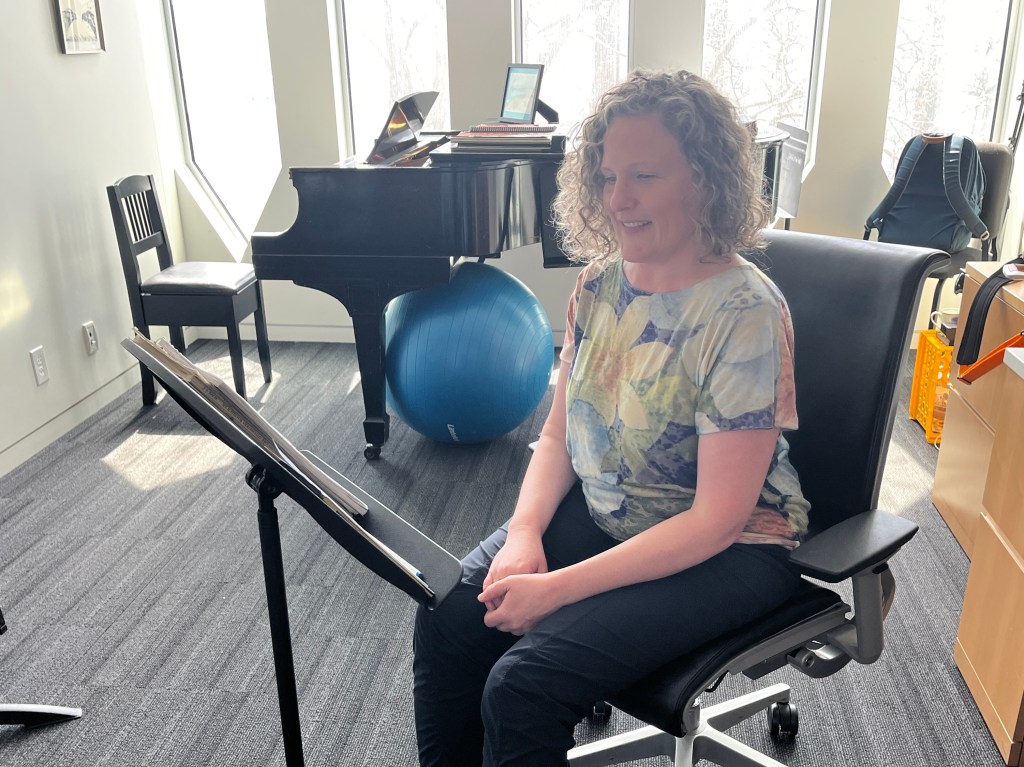
I also spoke to Professor Kirsten Docter in her studio to learn more about the chamber music program.
Sicily Xiao: Which kind of music will be featured?
Kirsten Docter: We have seven quartets playing nine pieces. There’s a piece by Rafiq Bhatia more like rock music. It is really driving, very rhythmic, and super fun to listen to. We have a more folksy piece by Rhiannon Giddens, an Oberlin graduate. There are much more introspective and quiet pieces during which people will be able to look around this space and see the artworks. Also a couple of them have emotional arcs that start sad and slow and then work up into some anger. The last piece by Paul Wiancko is more about friendship and relationships and the interaction of the quartet members.
SX: How do you select those pieces? How does the music program connect to the exhibition?
KD: It coincided with a visit from Sunny Yang, a wonderful cellist who played for many years with the Kronos Quartet. We saw it as an opportunity to combine two things. All pieces in the program are selected from 50 for the Future, a program led by the Kronos featuring contemporary works. Rather than make literal representations of AIDS/HIV or Christianity, we choose to present music that is by living composers, by female identifying, male identifying, and people from all over the world. I think that people will be able to draw parallels. We also have a quartet that starts with a Bach chorale, representing the Christianity part. The chorale ends with an A major chord. And when they get to the cadence, it will just be the beginning chord of Branching patterns by Inti Figgis-Vizueta.
SX: Branching patterns seems interesting, especially with improvisation in it. It is difficult to improvise in a quartet. How do musicians perform this piece?
KD: The improvisation part has definitely been a challenge. In improvisation, you want to have it a little more random and don’t want to have the same sense of pulse. But in a quartet you can’t just all do your own thing. You have to listen and respond. You’re trying to line things up and be precisely together without a conductor. Collaboration is the central thing.
Click here for more information.

 thecounterpoint.org