
Halfway through the performance of UNUM in Oberlin’s Wilder Main on Friday, February 23, two performers entered from stage right and paced slowly into center stage. Between players Penina Biddle-Gottesman and Fae Ordaz hung an instrument: several metallic strings were harnessed to the two of them and held taut. It was a fascinating device that mostly resembled a supersized guitar, and it just looked cool. Eventually, Biddle-Gottesman and Ordaz played the first note to emerge from this amazing invention… and what came out could only be charitably described as a note. The instrument made a low, untwangy thunk, and the coolness shattered.
So they continued, plucking the strings once every few seconds for upwards of ten minutes. Gradually, the thunks held for longer – and got increasingly distorted – but that was the only distinguishable difference throughout. The more monotonous it got, the more unpleasant it became, and that describes UNUM as a whole.
UNUM was a seventy-minute long multimedia performance by Arturo Orso, who was credited as composer, sound designer, producer, and editor. According to a promotional description, the event was a “devised production” — a collaborative process between its performers and “teams from sound design (TIMARA), composition, dance, set, costume, and lighting design, and cinema.” The benefits are that the performers have more creative input, but unless each aspect is well-coordinated, the results can feel aimless, as UNUM did.
The performance was split into six movements each credited to different conductors and performers. Movement One, by Orso, started with a faint rustle like a flowing waterfall, with ambient, slow string and woodwind accompaniment so distorted and faint they were almost unrecognizable.
Movement Two, by Phillip Chao and Sasha Paris-Carter, featured Paris-Carter occasionally playing a tom drum and once or twice singing an abrasive high pitch, accompanied by an ominous, distorted drone. Its placement between the softer, New Agey music of Movements One and Three let Movement Two stand out. Unfortunately, there was no moment within any single section that was distinguishable from another. Each was too long without retaining interest, which dragged down the entire production.
The most prominent aspect of UNUM was the dance component, directed by Olive Raymond and performed by Raymond, Marta Abrams, Ella Bezkorovainy, and Lindsey Chou. Between two and four of them were on stage during any given section, wearing flowy white layers of costuming that made them look like ghosts made of mist. During Movement One, they paired off and threw punches at each other, coordinating their dodging as if playing game after game of rock-paper-scissors. In Movement Two, three dancers crowded and moved robotically around Paris-Carter, and during Three, one ran back and forth between two others and retraced those steps as the movement ended, even after the other two had gone.
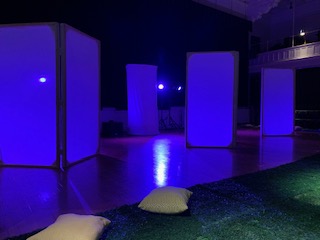
The set initially comprised three hinged frames draped in white cloth, used as pillars or mattresses during the first three movements, but went completely unused in the second half of the show with no set piece taking its place. Throughout, abstract color patterns lit the stage, and while the frame set pieces were there, the lighting projected off them. The absence of similarly creative set design in the later movements made the stage feel that much emptier.
So much work clearly went into making UNUM happen — the choreography, the high-pitched screams Paris-Carter sings, and the two-person stringed instrument — that it’s a shame it struggled to make its abstract sensibilities coherent. It was indistinguishable from a completely improvised performance. For all its ambitions, by the end of the production it could only be remembered for its few cool choices amid seventy minutes that evoked nothing.

 thecounterpoint.org