
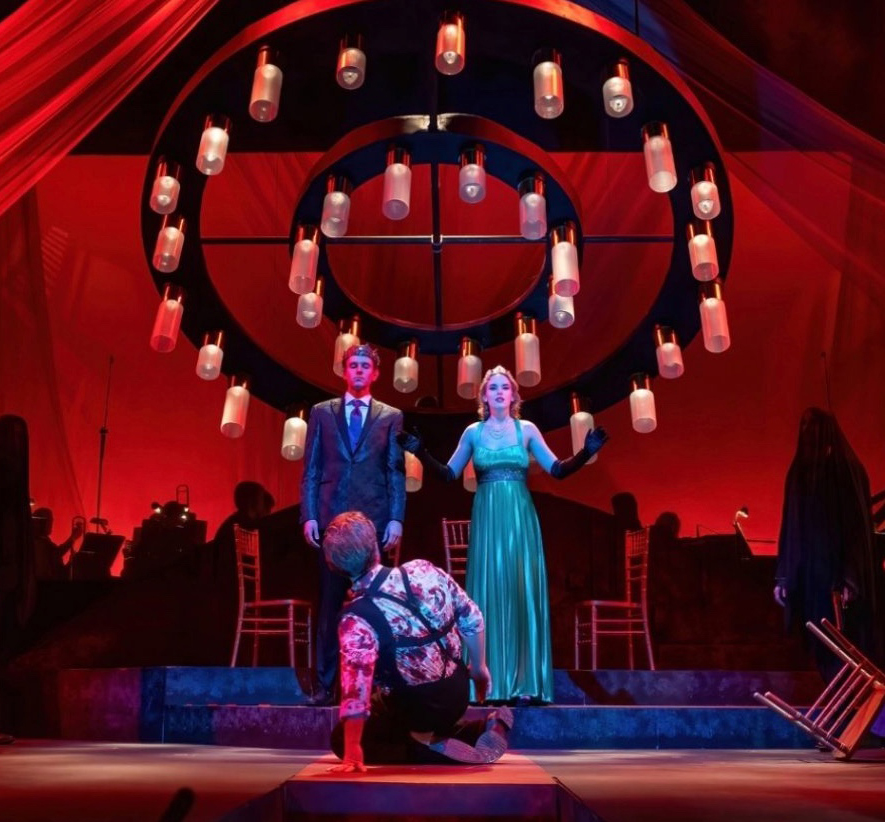
The central conceit of the Oberlin Opera Theater’s production of Claudio Monteverdi’s 1607 Baroque opera L’Orfeo, which opened the night of March 14th at Hall Auditorium, is “what if, instead of a lyre to supplement his legendary musical talent, Orpheus wielded a gun?” From that idea unfurls a production that reframes the Greek myth of Orpheus and Eurydice surprisingly creatively.
L’Orfeo is one of the oldest operas for which a full book and score still exists. This production was directed by Stephanie Havey and conducted by Christian Capocaccia, the latter leading an orchestra positioned on stage behind the rest of the set. The orchestra prominently featured period-accurate instruments, including theorbo, sackbut, viola de gamba, and harpsichord. Unfortunately, on Thursday, their placement out of the pit made the music less audible. Only the harpsichord, noticeably louder than all other instruments, was distinguishable from the ensemble.
However, as hard as it was to hear the work all the other instrumentalists brought, the staging vision Havey brought to the show was brilliant. The libretto is faithful to most versions of the myth, in which Euridice dies of a snake bite, but in this production, she died of a shot from Orfeo’s golden gun after he saw her spirited away by another man at their wedding.
Whereas in the original libretto Orfeo journeyed into the underworld out of grief, in Havey’s production he sought to right his wrongs. But he continued to use threats of violence to get what he wanted, he failed to change until it was too late, and he did not get Euridice back. The story became about his redemption, whether or not he deserved it. The original book was merely a tragedy of lost love, but Havey’s L’Orfeo was a haunting fable about the permanent consequences caused by the worst impulses.
This darker take on the libretto led to a powerful disconnect between the music and framing, and the actors brought fantastic performances to match. Each member of the cast brought clear diction to their music and gave their roles vivid life. Ava Paul gave an excellent performance as the Messagiera, whose words mourned Euridice and condemned the “snake” who killed her, but whose stance and tone made it clear the snake she sang of was Orfeo.
Also exceptional was Matthew Garvey as Caronte, the underworld’s ferryman, whose baritone voice switched from cold implacability to fright and stress after Orfeo threatened him with his gun. But the standout performer was Christopher Leimgruber as Orfeo, who brightly sang the warm, innocent words of the music and balanced them terrifically with the cold, violent actions his Orfeo commits, bringing an unsettling irony that powers the whole opera.
The show’s modern set by Laura Carlson-Tarantoswki and costuming by Chris Flaharty were creative and hard to ignore. In the opera’s first two acts, Orfeo and Euridice’s wedding featured the ensemble in luxurious suits and gowns that had everybody on stage looking their very best. Subsequently, Orfeo entered hell, a bleak, foggy realm of strewn-about empty chairs. There, only Pluto and Proserpina retained the wealth of eternal life with their costumes on display. Everybody else, with costumes obscured by black veils, lost their individuality, beauty, wealth, and life.
With each component of the vision combined, this production of L’Orfeo was more than excellent. It decided against being lazily obedient to the source material, and that choice resulted in a profoundly creative opera with an irreplicable viewing experience.
Photo: Scott Shaw, clevelandclassical.com

 thecounterpoint.org